Shane and Ilya Play Together for the First Time at the All-Star Game
Heated RivalryShane and Ilya Play Together for the First Time at the All-Star Game is a rare public convergence of two lives that have long run on separate tracks: the rivals can finally play on the same side, while the private intimacy concealed beneath their rivalry is briefly visible in Ilya’s impulsive kiss. The game makes their compatibility legible first through hockey, then through a gesture that can pass as one more provocation because that is what the audience expects from them.
Background and Stakes
The opportunity comes only after six All-Star Games. Injuries and the league’s unusual, gimmick-driven team arrangements had kept Shane Hollander and Ilya Rozanov from being teammates before. Now, for the first time, Shane will experience what it is like to play with Ilya rather than against him. The novelty matters to both men: Shane wants to see Ilya that weekend, alone behind closed doors, and is tired of pretending otherwise; Ilya has been waiting a long time to play with Shane.
The event also arrives inside a public story already written for them. The press treats their pairing as a monumental test of whether the supposed enemies can put aside their animosity and cooperate. Shane knows how much that framing conceals. His private smile at the prospect of playing alongside Ilya carries the thought that the press does not know the true nature of their connection. Their shared shift is therefore both a sports spectacle and an encounter shaped by the secrecy surrounding their relationship.
A New Line and Immediate Chemistry
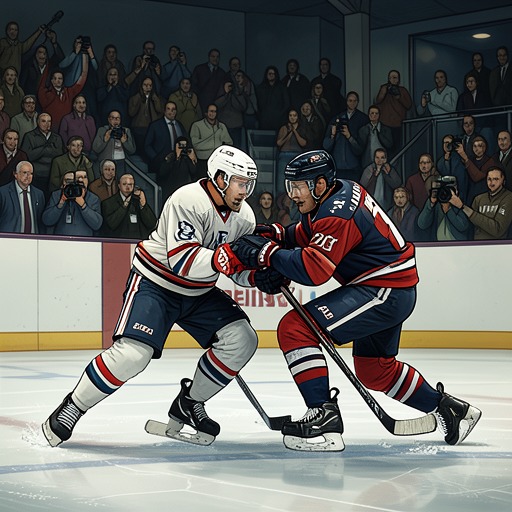
Ilya changes positions to make the pairing possible, moving from center to right wing so he can play on a line with Hollander. He is glad to do it; playing with Shane is not merely an assignment but an opportunity he has wanted for a long time. The adjustment places them alongside Carson, the left wing, but Ilya’s attention is almost entirely fixed on Shane.
Their understanding arrives more quickly than their preparation could explain. They have had little time to practice together, yet Shane can keep pace with Ilya, and their passes seem to anticipate each other. Ilya regards their connection as unlike anything he has experienced with another player; the ease of it is exhilarating. Carson is left, in Ilya’s view, with little presence in the game as Ilya becomes absorbed in the partnership beside him. The contrast between their minimal practice and their near-instinctive coordination makes the line’s success feel less like a tactical arrangement than a connection already waiting to be used on the ice.
The Fourth Goal
The clearest demonstration comes during a rush. Ilya receives a pass from a defenseman and accelerates; when he looks left, Shane is right there with him. After crossing the blue line, Ilya sends the puck to Shane. Shane knocks it back, Ilya returns it at the last moment, and Shane shoots cleanly into the top corner. It is Shane’s fourth goal of the game.
The sequence depends on repeated exchange rather than one player’s individual effort: Ilya carries the puck forward, Shane stays alongside him, and the two return the pass until the opening appears. Their ability to read and respond to each other turns a short play into a vivid answer to the press’s question about whether they can work together. On the ice, they do not need to overcome their supposed animosity; their movement already shows how naturally they can cooperate.
A Kiss That Can Pass as a Taunt
Shane raises his arms, beaming, his eyes crinkled and cheeks flushed. Ilya embraces him, and Shane wraps both arms tightly around Ilya. Ilya feels Shane’s breath against his neck and sees sweat glistening on his skin before kissing him hard on the cheek. The celebration is intimate in its physical closeness, but Ilya understands that the crowd is likely to read the kiss as his familiar, obnoxious way of irritating Hollander. The rivalry gives the gesture a ready-made public explanation.
That explanation does not describe Ilya’s impulse. He kisses Shane because he sees the opportunity and cannot help himself. Shane laughs in surprise, while Ilya’s cheeks flush, an unusual and uncomfortable reaction for him; he then praises the goal. The moment holds both versions of their relationship at once: a public display that can be dismissed as mockery, and a private act prompted by Ilya’s feelings. Its significance lies not in a public revelation—the kiss does not expose their secret—but in how the familiar rivalry lets genuine affection appear without being recognized as such.